The first step to find out what users think

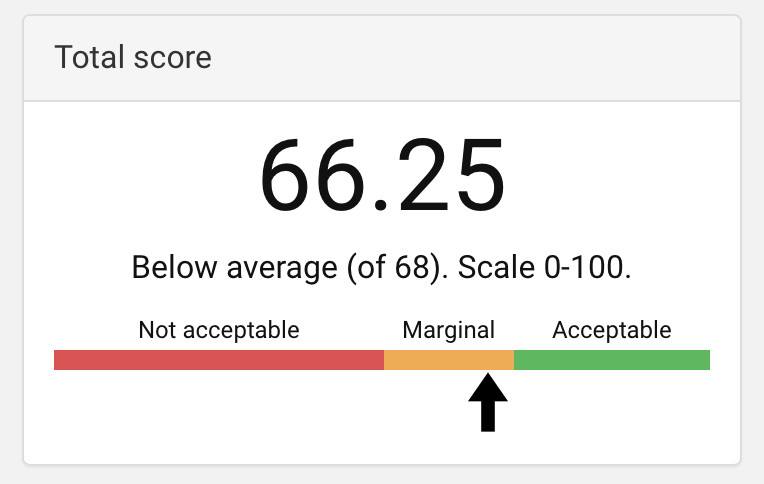
Empowering everyone to evaluate usability can improve the digital workplace. Here is how you take the first step with userpoll.io. Bad software makes a bad digital workplace Organizations that have been around for a few years typically have a large number of legacy systems. Ages ago, when they were created, it is likely that no one cared about their usability or design. Users were used to obeying software and taking a course in order to be able to file a report. This is particularly true for the public sector where competition between vendors is low and barriers for newcomers is high. We need to fix it to make our organizations a better place to work. ...

June 7, 2015 · Peter Krantz

Keeping goals to yourself increase chances of completing them?

Did you think that by announcing your goals you would feel more pressure to work to achieve them? Apparently works the opposite way. When Intentions Go Public - Does Social Reality Widen the Intention-Behavior Gap? by Peter M. Gollwitzer et al.

January 2, 2012 · Peter Krantz

Changing energy behavior with real-time feedback

In this blog post I try to put household energy usage in a control theory context to see if we can find better ways to influence behavior. A lot of people are thinking about how we can reduce household energy use these days. Changing household energy use can be a challenge because to most people there is no working feedback loop available. Energy use is invisible. My own feedback loop consists of getting a monthly invoice displaying the cost I had for the previous month (e.g. “278 SEK”). That is a lousy feedback loop if you want to change behavior. I can not even see how much energy I used. Not that it matters because that information is useless without knowing what would be a reasonable level to compare with. And getting the information once a month does not provide a feedback loop for me to see the effect of my immediate behavior. ...

July 4, 2011 · Peter Krantz

The case for uninterrupted work

Ho do you manage your interruptions? The myth of multitasking: … [a] research study, funded by Hewlett-Packard and conducted by the Institute of Psychiatry at the University of London, that found, “Workers distracted by e-mail and phone calls suffer a fall in IQ more than twice that found in marijuana smokers.” Stanford study: Cognitive control in media multitaskers: Results showed that heavy media multitaskers are more susceptible to interference from irrelevant environmental stimuli and from irrelevant representations in memory. This led to the surprising result that heavy media multitaskers performed worse on a test of task-switching ability, likely due to reduced ability to filter out interference from the irrelevant task set. ...

October 11, 2009 · Peter Krantz

Reducing distractions, increasing productivity

I have been trying to reduce distractions in my computing environment lately. Apparently, our brains aren’t wired properly for task switching: …research has also found that multitasking contributes to the release of stress hormones and adrenaline, which can cause long-term health problems if not controlled, and contributes to the loss of short-term memory. I spend a lot of time in front of my computer every day. I discovered that over time, I have added so much attention-stealing stuff to my main work environment that I feel constantly interrupted. You get growl notifications, tweets, new email sounds, new email icons, RSS feed notifications and IM alerts. When you are reading stuff on the web you are constantly bugged by the latest in advertising technology. ...

July 11, 2008 · Peter Krantz

Defining Characteristics of a Successful Software Project

Lately, there has been some really interesting presentations and articles on agile methods and how they fit into the big picture of software development. One that was particularly interesting was Scott Ambler’s 2007 IT Project Success Rates Survey (also see the Javapolis presentation). It presents some information that is different from how the Standish Group defines success in their often refered to CHAOS report. The Standish Group assumes that success is the traditional “on time, on budget and on scope”. In many ways this does not make sense as an estimate of time and budget are made when the least information is available (early in or before a project starts). ...

May 10, 2008 · Peter Krantz

Rapid prototyping makes usability testing easier

In an article over at Dancingmango Marc McNeill writes about how new web development frameworks such as Ruby on Rails will have an impact on usability testing practices (“What’s the point of usability testing”). The only real reason to test a mockup instead of a real application is of course that it used to be more expensive and time consuming to create an application. With Rails there is no such barrier anymore and usability tests can (and should) be using the real application instead. It is likely that this will lead to a better understanding of how users behave in e.g. a task based system. ...

June 28, 2006 · Peter Krantz

Scrum, Lies and Red Tape

Philip Su from Microsoft gives us a glimpse of the inner workings of one of the most complex software projects in the world. It is interesting to see that the same problems that sometimes plague small waterfall projects (lies, red tape) exist in an organization that have put a lot of effort into their development methodology. At a recent Scrum training session Ken Schwaber said “it’s all bout telling the truth”. Philip’s post contains some interesting quotes related to this topic: ...

June 15, 2006 · Peter Krantz