A lightweight semantic interoperability framework for countries and large organizations (and small ones)

This post is a summary of some ideas for a lightweight semantic interoperability framework It is mainly a composition of existing open standards to form a framework for organisations to be able to ensure that semantic and technical descriptions stay connected over time. The idea is to provide a framework that allows for an increasing semantic interoperability emerging over time without having a large centralized organisation defining vocabularies. Main points: The benefits appear when a vocabulary is used. An important factor is how a vocabulary and its parts can be published, discovered and referenced. There needs to be one and only one vocabulary artifact. The vocabulary artifact must be machine processable to allow aggregation and automatic generation of other artifacts. Background The need for interoperability arise in scenarios with many contributing actors. In the old days this was solved by hiring a (large) consulting organization that (hopefully) had experience from glueing together many products from their vast product portfolio. Everyone involved was happy if it worked. Being able to swap out a part of this system or connect it to a third party that had a different technical platform was considered a risk. ...

December 15, 2010 · Peter Krantz

Making FuzzyFinder work in MacVim 7.3

I have seen many posts that are having trouble getting FuzzyFinder to work in MacVim. In certain configurations you will see multiple errors “E806: using Float as a String”. This is because some locales make MacVim treat floating point numbers differently. Here is how I did to make it work on my system (OS X 10.6.4 and MacVim 7.3). As an added bonus we will map it to the Apple-T key and default it to subdirectory search. ...

September 28, 2010 · Peter Krantz

A short summary of Codemocracy 2010

On september 4-5 we had our first open data hack day here in Sweden called Codemocracy. The event was a success (thank you Martin Svalin!) with close to 50 participants hacking away at various data sets. I did an intro on the state of open data but tried to keep it short so that everyone could start coding as soon as possible. On Sunday there were 12 teams presenting their apps. Some of the teams had used public transport data made available by the Viktoria Institute but many were scraping government websites for lack of proper API:s. In the 24 hours set aside for the competition the following apps were created: ...

September 12, 2010 · Peter Krantz

Beta testing the UR TWEETS SUCK Tee

My son has the dubious pleasure of being the primary beta tester of T-shirt messages. This time it is the first draft of the model that will be called “Twat”. Turned out pretty OK… Also see the Ballmer Tee.

August 26, 2010 · Peter Krantz

Implement open data for EU institutions

Jonathan Gray of the Open Knowledge Foundation participated in a conference of the Communia project, a European thematic network on the digital public domain. In a great post about the meeting at the OKFN blog, he recommends two improvements to the current PSI work; 1: Broaden the scope of the PSI Directive to include publicly funded cultural heritage organisations and 2: Broaden the evidence base for opening up PSI. A third recommendation An important value of public sector information is the increased transparency in government decision making. A European Union directive only affects member states and not EU institutions. We are therefore at risk of missing out on increased transparency in EU institutions that the PSI directive may bring to governments in the member states. Also, government transparency is often considered to be a contributing factor in reducing corruption. ...

July 12, 2010 · Peter Krantz

Politiska partier på Twitter 2010 – ett analysunderlag

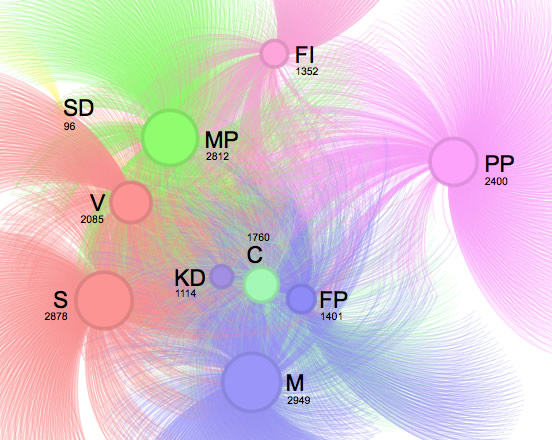
Hur använder politiska partier Twitter som kommunikationskanal? Är de där för syns skull, finns det riktiga människor bakom kontot och deltar de i dialog? Genom att hämta data från Twitters API (ett slags gränssnitt för datorer där man kan läsa ner den öppet synliga information som finns på Twitter) kan man sammanställa information på ett sätt som förhoppningsvis gör att det blir lättare att resonera kring frågorna ovan. Partierna som ingår i underlaget är Centerpartiet, Feministerna, Folkpartiet, Kristdemokraterna, Miljöpartiet, Moderaterna, Piratpartiet, Socialdemokraterna, Sverigedemokraterna och Vänsterpartiet. Samtliga har ett användarkonto på Twitter som jag uppfattat som det officiella kontot för partiet. Tillsammans har de ca 16000 följare (användarkonton som är kopplade till partiets användarkonto) och har gjort ca 9000 inlägg. I nästa nivå, antalet följare till varje följare, finns uppskattningsvis ca 10 miljoner användarkonton. Denna information kan ange den potentiella räckvidden i andra nivån av vidarebefodrade meddelanden (s.k. “re-tweets”). ...

May 11, 2010 · Peter Krantz

Social Media in the Swedish Public Sector

Andrew Krzmarzick, Govloop community manager, asked me which swedish government agencies are using social media to communicate with citizens. The twitter message space is too short for an answer so here is a more thorough reply. I will specifically look at Twitter which seems to be gaining popularity in the swedish public sector. Use of social media tools in the public sector is in its infancy in Sweden. In a study conducted by the Stockholm Chamber of Commerce in 2009 (PDF) , around 12% of agencies reported that they were using social media channels in their communication. In another study by the Swedish Public Relations Association 75% of PR managers were evaluating the use of social media but only 5% had involved social media in the communication strategy. Many agencies are trying out new tools to see how they fit in their communication strategy. Most are using them as a news feed (one-way communication) and do not reply to questions. The number of followers varies greatly. Some examples: ...

April 8, 2010 · Peter Krantz

Joining the Swedish eGovernment Delegation

A while ago I was offered a position with the Swedish eGovernment Delegation. I will be working with IT standardisation issues and the next revision of guidelines for public websites.

November 21, 2009 · Peter Krantz

Dear DHL (and all other logistics companies)

Dear DHL (and other logistics companies because you tend to behave exactly the same). How is it that you are able to move my package from the UK to Sweden fast as hell but spend several days trying to move it from your terminal to my home address in the same city? Visa DHL delivery på en större karta Like most people living in Stockholm (and other cities I guess) I live in an apartment building to which you have no access. Also, like most people, I work during the day. Nothing special, just normal office hours, about the same hours when your drivers drive around the city trying to deliver stuff to the empty homes of people who are at work. ...

October 28, 2009 · Peter Krantz

The case for uninterrupted work

Ho do you manage your interruptions? The myth of multitasking: … [a] research study, funded by Hewlett-Packard and conducted by the Institute of Psychiatry at the University of London, that found, “Workers distracted by e-mail and phone calls suffer a fall in IQ more than twice that found in marijuana smokers.” Stanford study: Cognitive control in media multitaskers: Results showed that heavy media multitaskers are more susceptible to interference from irrelevant environmental stimuli and from irrelevant representations in memory. This led to the surprising result that heavy media multitaskers performed worse on a test of task-switching ability, likely due to reduced ability to filter out interference from the irrelevant task set. ...

October 11, 2009 · Peter Krantz